Clear photos
Include the complete gripper, mounting side and surface that contacts the part.
Replacement robot gripper pads
Request a feasibility review for a worn, unavailable or unsuitable contact pad. Start with the existing interface before selecting a sample route or evaluating contact changes.
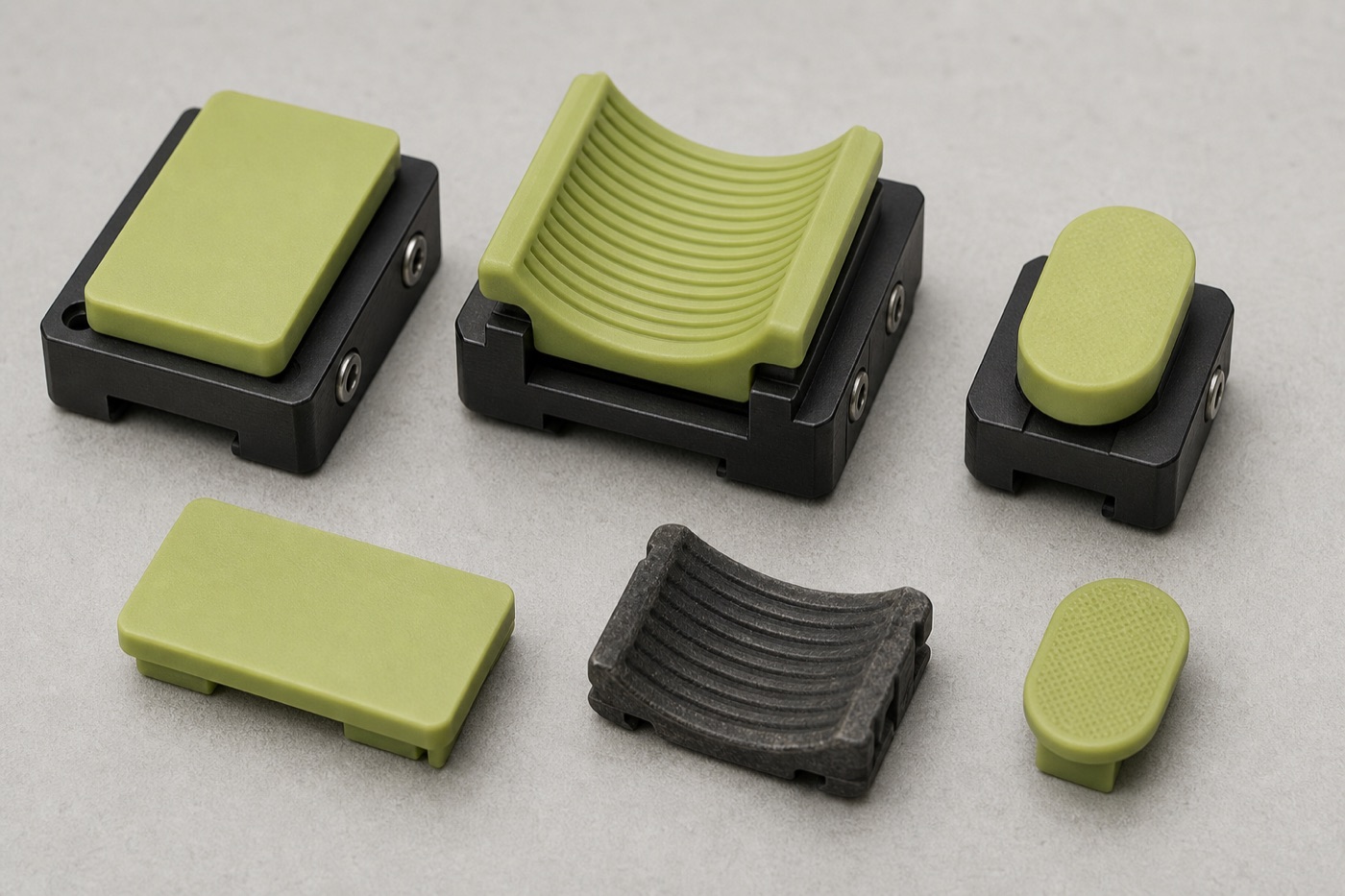
Why buyers replace a pad
Use what you already have
The first review is about recovering the mounting interface, contact geometry and operating conditions. One reliable reference is often enough to identify a practical route.
Include the complete gripper, mounting side and surface that contacts the part.
Useful when the part can be measured and the original interface remains identifiable.
Overall size, hole spacing, pocket depth and contact thickness help establish feasibility.
Existing geometry can be reviewed directly when STEP, STL, DXF or dimensioned drawings are available.
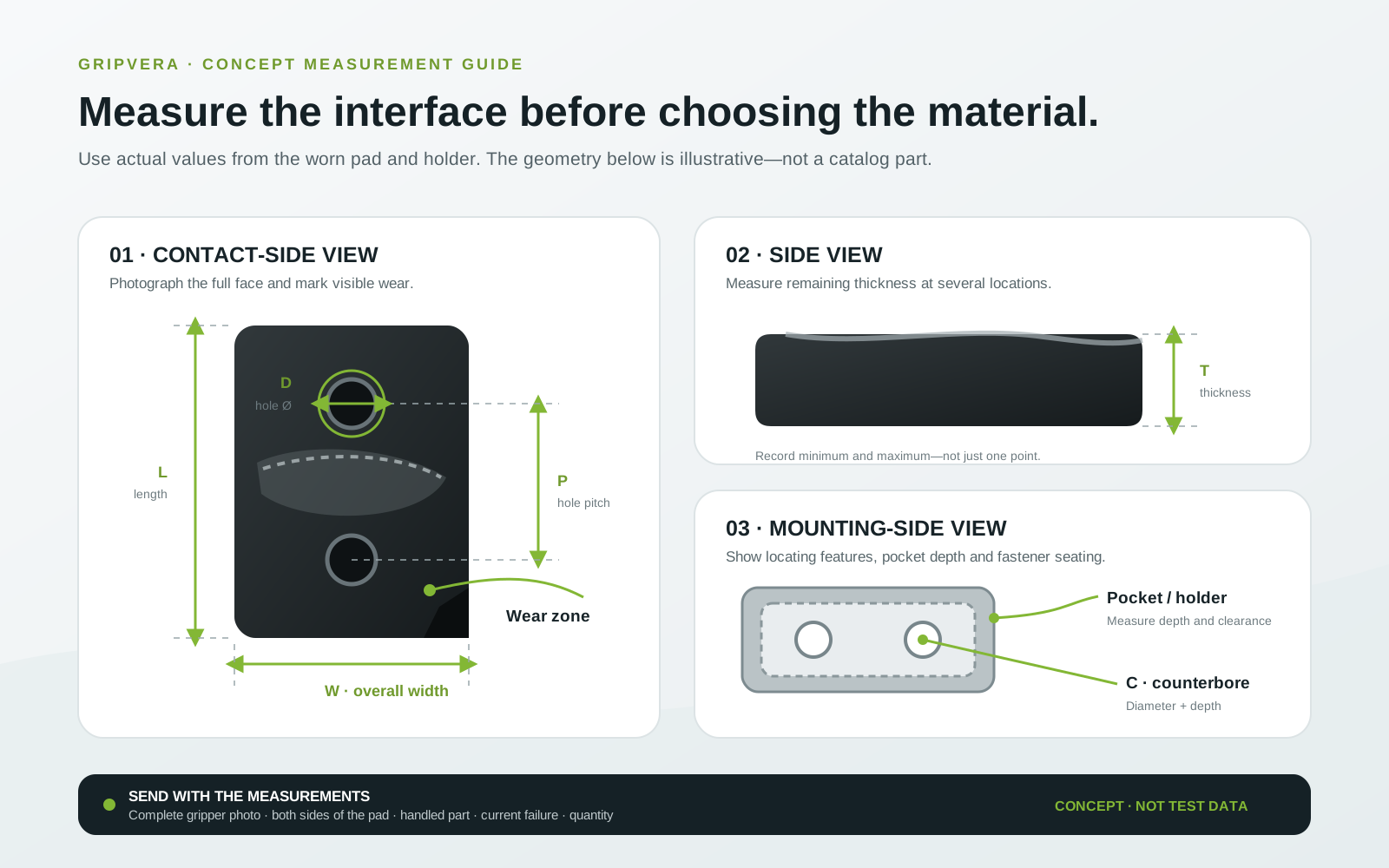
Measure before material selection
Width, length, remaining thickness, hole pattern, counterbores and holder clearance help separate dimensions that must stay compatible from contact features that may be reviewed.
Reproduce or improve
The initial review separates interface requirements from contact variables. Any material, hardness, fastening or performance claim remains subject to supplier review and an application trial.
Review the screw pattern, locating features, pocket, holder condition and available clearance.
Flat, grooved, patterned or part-contoured surfaces can be compared as design directions.
Selection follows the workpiece, environment and proposed manufacturing process—not a generic material list.
Fastening, replaceable inserts or bonding are considered only after the holder and process are reviewed.
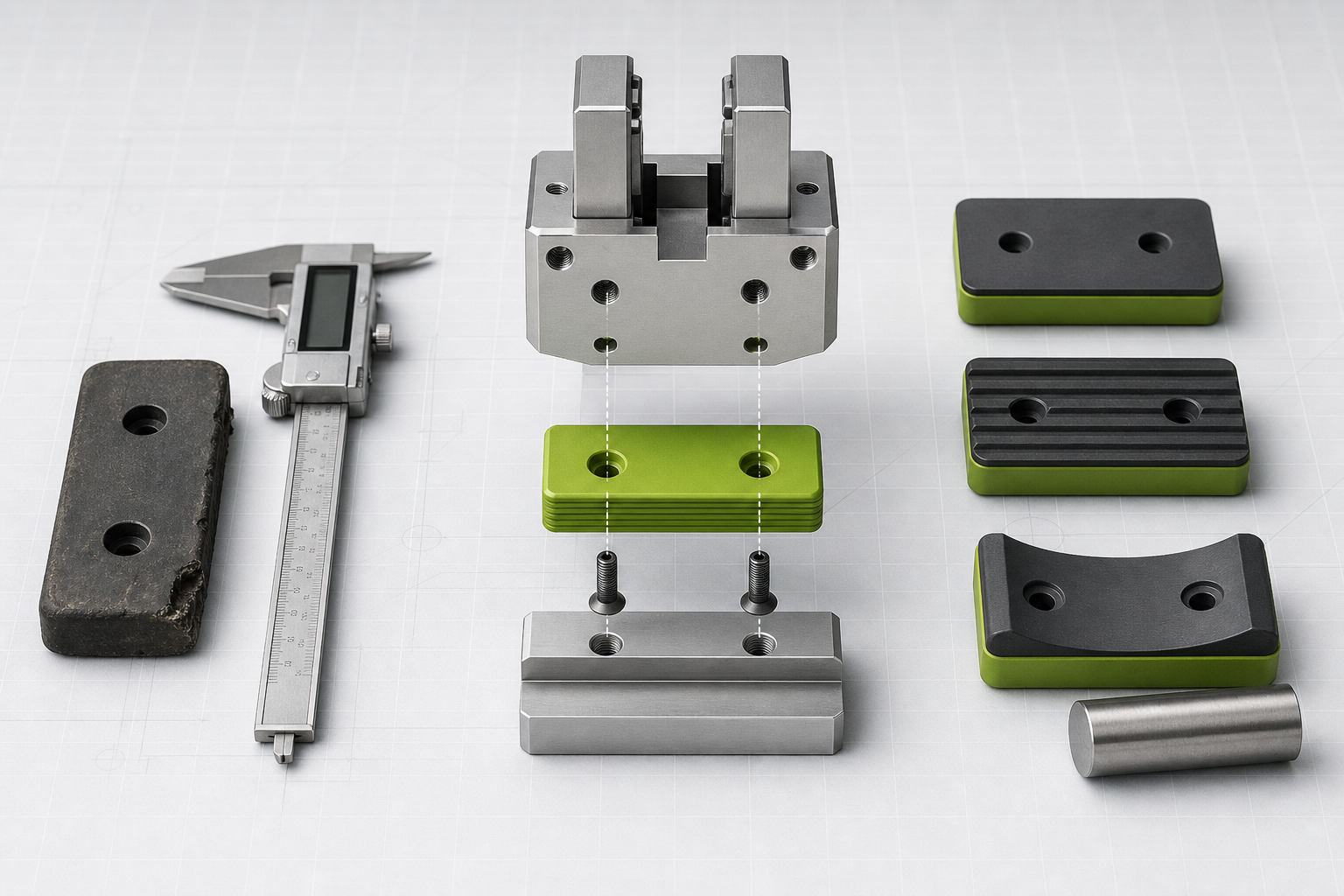
Digital concept study
This original visual explains how flat, grooved and contoured surfaces might be compared before a physical sample route is selected.
A short replacement path
The objective is not simply to copy a shape. The replacement must fit the gripper, hold the workpiece consistently and survive the intended environment.
Review the gripper, old pad, workpiece, failure and operating environment.
Identify fixed dimensions without automatically copying wear as original geometry.
Confirm process, included revisions, quantity, fee and timing before work begins.
The customer checks installation, clearance, grip, marking, retention and early wear.
Use an approved drawing, specification and revision identifier for repeat orders.
Start with one useful message
Send two or three of the items listed here for an initial feasibility review. If a pad-only change cannot solve reach, interference or load-position problems, describe that in the same inquiry for a custom-finger review.
View all GripVera contact partsDirect: sales@meccamore.com
Practical answers
Clear photos, accessible measurements and the gripper model may be enough for an initial feasibility review. A physical sample or additional measurements may still be required before a sample quotation.
You can describe the current problem and required result. A material or hardness direction is then reviewed against the workpiece, environment and proposed manufacturing process. No improvement is assumed until a sample is tested.
That is the preferred starting point. The interface can only be confirmed after the mounting features, clearance and condition of the existing holder have been reviewed.
That depends on geometry, material, tolerance, quantity and intended production process. The sample route and any tooling charge are identified in the quotation.
The customer or system integrator must validate installation, collision clearance, grip stability, marking and wear in the actual machine. An engineering sample is not a safety certification or a general lifetime guarantee.