Exact model
Manufacturer, model, stroke and available interface information establish the fixed starting point.
Custom robot gripper fingers
Request a feasibility review when standard fingers cannot reach, locate or hold a defined part. Keep the existing gripper and mounting interface as the first project boundary.
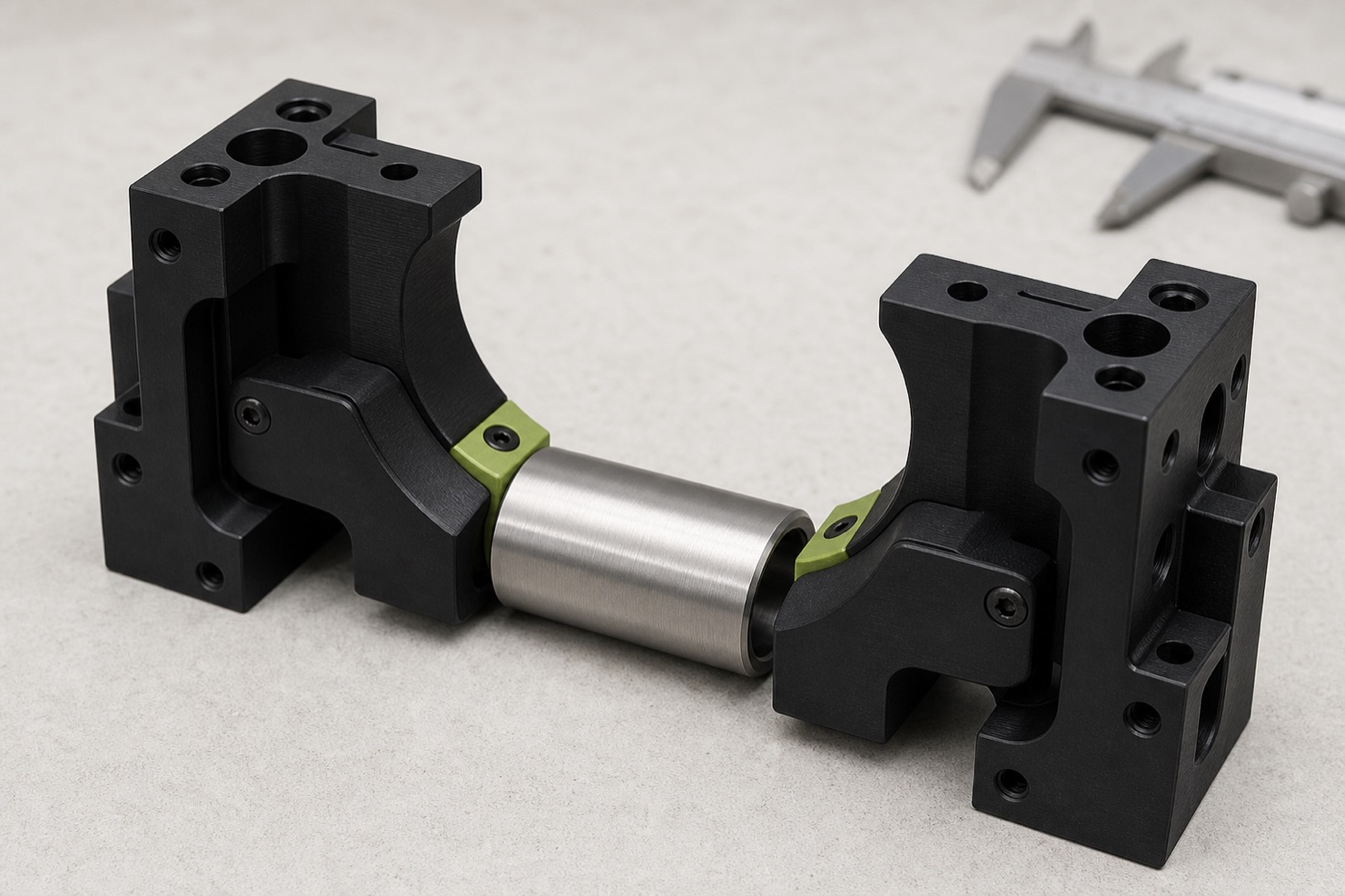
When standard fingers fall short
Define both sides of the interface
A useful first review connects mounting, stroke and clearance to the exact contact geometry required by the handled part.
Manufacturer, model, stroke and available interface information establish the fixed starting point.
Show the part, grip direction, important surfaces and the feature that should locate the pick.
Describe reach, rotation, slip, marking, interference or another reason the standard fingers fail.
State weight, orientation, acceleration, oil, coolant, temperature and expected cycle conditions.
Guard the existing system
A custom finger can alter reach, load position, inertia and clearance. Those effects must be reviewed before selecting a sample route.
Use reliable dimensions, locating features and fastener details from the actual gripper or manufacturer information.
Check the required opening, approach path, neighboring equipment and full gripper motion.
Define where the part should be supported, located and released rather than copying a visual contour alone.
Finger overhang, weight and load position remain subject to the gripper manufacturer's limits.
Material, tolerance, finish and manufacturing route are proposed only after supplier and application review.
Feasibility before manufacture
The purpose of the first sample is to expose interface, clearance and contact problems under the customer's actual machine conditions.
Confirm the gripper, workpiece, failure, environment, quantity and expected result.
Review mounting, stroke, overhang, load position and available motion clearance.
Choose a geometry direction that supports, locates and releases the defined part.
State process, included revisions, quantity, fee and timing in a project-specific quotation.
The customer tests fit, motion and grip before an accepted revision is used for repeat orders.
Start with one defined pick
Send two or three useful references for an initial feasibility review. If only the worn contact surface needs replacement, use the replacement-pad route instead.
Review replacement robot gripper padsDirect: sales@meccamore.com
Practical answers
Start with the exact gripper model, handled part, current limitation and available photos, dimensions or CAD. Interface drawings, load information and motion constraints may be required before quotation.
A model-specific review can begin when reliable interface information and manufacturer limits are available. Compatibility, fit and acceptable loading are not assumed from the model name alone.
That depends on the diameter or geometry range, available stroke, grip direction, required location and allowable contact movement. Define the complete part family before a common geometry is evaluated.
The customer or system integrator must validate installation, clearance, motion, grip stability, marking and wear on the actual machine. An engineering sample is not a safety certification or a general performance guarantee.